A comprehensive overview :
> Making a good referral
> The 5 outcomes
Occupational Health (OH) plays a crucial role in enhancing employee health, workforce productivity, and business performance: assisting organisations in meeting their statutory and ethical responsibilities (Society of Occupational Medicine (SOM) 2017). The impact of OH interventions, however, hinges significantly on the quality of the referral process and assessment, which requires effective communication and partnership between OH and Management (Faculty of Occupational Medicine (FOM) 2017).
For OH to provide meaningful and actionable guidance, referrals must contain clear direction, relevant clinical detail and workplace information (FOM, 2017). Similarly, OH professionals must understand the operational pressures and objectives driving referrals. This ensures recommendations are relevant, practical and useful to the organisation (O’Neill, 2020).
This article outlines the principles of a high-quality OH referral and introduces the structured framework, the Five Key Outcomes Model. This model directs managers to the information they must include at the point of referral; supports consistent, evidence-informed OH assessments and therefore reports that provide a clear direction for action.
Making a good referral: laying the foundations for a successful OH assessment
An early referral to OH (whether workplace performance, wellbeing, or absenteeism) supports an earlier resolution and helps positive working relationships between the employee and management (NICE, 2019; PAM Group, 2023).
An effective referral includes relevant context, consent, transparency, and communication (FOM, N.D.). The referral should be clear, factual, and focused on the workplace implications of health, not clinical diagnosis (FOM, 2017). When referrals lack these elements, reports can become limited, overly cautious, or insufficiently targeted to meet the referrer’s needs. Poorly constructed referrals hinder the clinician’s ability to address the specific occupational issues and risks, misalignment with the needs of the business and the employee.
As an OH clinician, there is nothing more disheartening than receiving a poor referral. Together, we should focus on the person’s functional abilities, health limitations, possible adjustments, and realistic timescales.
When referrals lean too heavily into medico-legal territory, they can dilute the value of the report, leaving everyone involved frustrated and without clarity. OH professionals are here to support both managers and employees, collaborating to find practical solutions for work and health. A well-framed referral sets the tone for a constructive, collaborative outcome.
What does a good referral look like in practice?
» Employee consents to the referral
The referral should be shared and discussed with the employee under data protection rights (ICO, 2018) before submission. Transparency ensures informed consent and helps preserve trust. Employees will engage constructively if they understand the process and feel it is fair, thereby reducing the risk of consent being withdrawn or the consultation not proceeding.
» Define what you need to know
Be specific! Avoid generic or medical questions; OH is there to assess fitness for work, not to diagnose or treat.
Consider:
- Can the employee safely conduct their role?
- What adjustments can the employer put in place to support a sustained return to work?
- What are the likely timeframes for recovery or review?
» Provide relevant and factual information
Ensure the referral includes:
- A full list of absence dates and reasons, particularly where there are concerns about attendance patterns. This allows the clinician to consider an underlying disability or identify an unusual pattern of absence, informing further questions
- All known outcomes of individual risk assessments, if already completed.
- A list of any adjusted duties or return-to-work arrangements already trialled, with dates and outcomes, and any potential adjustments that can be considered (with timescales), but remain flexible.
- A clear outline of the functional demands of the role, e.g. standing for prolonged periods, handling machinery, materials handling, and concentration needs. Avoid relying solely on HR job descriptions.
- A factual summary of any management concerns or operational difficulties observed, such as performance issues related to fatigue or mobility concerns.
- All relevant health and lifestyle issues an employee is experiencing. Not doing so will risk an ineffective triage and undermine the value of OH input. Triage determines the appropriate clinician and time allocation. Either being affected could lead to an ineffective assessment, compromising the consultation and report. Leading to frustration for all parties.
Example: HR requested an assessment focused solely on the employee’s fatigue and not contributing factors such as sleep issues, menopause, or anaemia, believing these were irrelevant. However, clinically considering these issues led to self-management strategies in reducing fatigue and improving health and, therefore, performance.
» Keep it supportive and objective
- Keep the tone neutral and professional.
- Referrals perceived as disciplinary or punitive can undermine trust and create barriers to open communication between the employee and clinician due to defensiveness, hindering effective outcomes.
- A supportive referral is more likely to lead to a collaborative and beneficial outcome for all parties.
» Disability under the Equality Act
It is the employer’s responsibility to make enquiries as to whether an individual is likely to be disabled under the Equality Act 2010. OH professionals have a responsibility to provide an informed opinion where requested, based on available clinical evidence. The final determination of disability status rests with the courts or tribunals, except for those automatic disabilities of cancer, HIV, blindness, and Multiple sclerosis (MS).
Understanding the five potential OH outcomes
Frustrations with OH assessments often arise when reports lack clear direction, leaving managers unsure how to act.
The Five Outcomes Model is a practical framework designed to support clinicians and managers by bridging the gap between clinical advice and workplace action. By aligning clinical recommendations with operational realities, the model helps drive better decisions, more efficient processes, and stronger outcomes for employees, teams, and organisations alike.
Feedback indicates OH clinicians structure their reports with greater clarity, consistency, and relevance to the working environment. Providing managers with a straightforward interpretation of what the advice means and the steps they should take in response. Employees have more control to make informed decisions about their health, work and future planning.
Every OH report should support one of five broad outcomes. Understanding these helps management frame their expectations and ensures the referral generates actionable advice.

The five potential OH outcomes
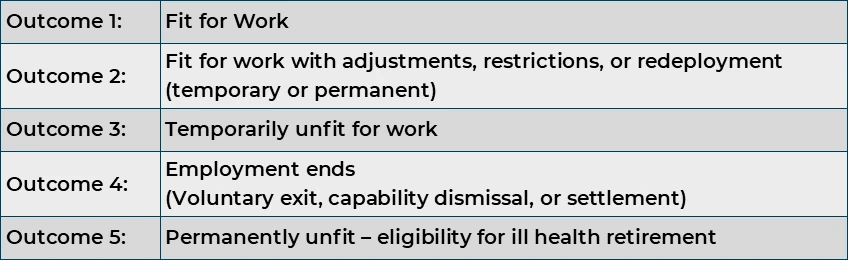
Outcome 1 : Fit for Work
What this means:
The employee is fit to resume their role without restrictions.
OH report includes:
- Clear statement of fitness.
- Date from which the employee is fit.
- Confirmation that no adjustments are needed.
- Recommendation to undertake regular welfare meetings if they have continuing health problems.
Suggestions for managers:
- Confirm return-to-work arrangements.
- Return to normal duties with ongoing management review to ensure everything remains on track and their health status.
- No further support or adjustment required unless new issues emerge.
Outcome 2: Fit for work with adjustments, restrictions, or redeployment (temporary or permanent)
What this means:
The employee can return to work with temporary or permanent adjustments, restrictions or redeployment measures to support a safe and sustainable return.
OH report should include:
- Functional limitations (e.g., avoid heavy lifting, limit standing).
- Recommended adjustments (e.g., low-risk manual handling tasks with limited vertical lifting range, reduced hours, seated work).
- Recommended self-management.
- Timescales and whether adjustments are temporary or permanent.
- What workplace exposures need to be avoided, or work-related issues that need to be investigated and managed.
- Psychosocial issues may be a barrier to returning to work or require consideration (e.g. carer’s duties, spouse or dependents’ serious health issues, childcare challenges).
- Whether the health condition may fall under disability provisions of the Equality Act if asked.
It is the responsibility of management to determine whether any recommended adjustments are reasonably practicable to implement; occupational health can advise on options, but the final decision rests with the employer.
Management action:
- Discuss the recommendations with the employee and decide whether adjustments (temporary or permanent) in line with advice are reasonably practicable in the specific circumstances. If not, decide what is feasible and confirm expectations regarding the length of time of adjustments, review periods and whether contractual changes are required, ensuring compliance with the Equality Act 2010 where applicable.
- Regularly review and monitor the effectiveness of the adjustments.
- Consider re-referral to OH if the temporary adjustments have been implemented and the employee is unable to resume substantive duties within confirmed expectations.
Outcome 3: Temporarily unfit for work
What this means:
The employee is currently unfit to return to work due to illness or recovery needs, but OH anticipate a return.
OH report should include:
- Estimated recovery timescale.
- Current treatment or rehabilitation activities, including potential impact of additional employer-funded support options.
- Potential for rehabilitative return in the future, what temporary or permanent adjustments or restrictions may be required to support the return to work and the likelihood of sustained attendance on return.
- Any workplace exposures that the employee needs to avoid or work-related issues that need to be investigated and managed.
- Any psychosocial issues may be a barrier to return to work or require consideration (e.g. carer’s duties, spouse or dependents’ serious health issues, childcare challenges).
- Suggestions for reassessment if applicable or the employee does not achieve a return to work as anticipated.
It is the responsibility of management to determine whether any recommended employer-funded support options or adjustments are reasonably practicable to implement; occupational health can advise on options, but the final decision rests with the employer.
Management action:
- Maintain contact and manage in line with sickness absence policy.
- Discuss the recommendations with the employee, decide whether they are reasonably practicable in the specific circumstances, ensuring compliance with the Equality Act 2010 where applicable.
- Consider recommended support options (e.g. EAP, physiotherapy)
- Schedule a review OH assessment if the employee has not achieved the return to work in the anticipated timescale.
Management should consider how long they can reasonably sustain a continuing absence and have open, honest conversations with the employee to avoid any surprises. Employees must understand their value and that their absence is genuinely felt within the team.
Outcome 4: Employment ends (Voluntary exit, capability dismissal, or settlement)
What this means:
The employee is unlikely to return in the foreseeable future, and medical evidence supports an exit from employment.
OH report should include:
- Evidence of functional limitations or incapacity.
- Likelihood of sustained inability to conduct any relevant suitable work.
- Likelihood that functional limitations will change even with treatment, within a stated period or foreseeable future.
- Attempts made to support the employee.
- Neutral, factual language (not a dismissal recommendation).
- Whether the health condition may fall under disability provisions.
Management action:
- Begin formal process under capability or HR policy.
- Ensure transparency throughout the consultation process.
- Ensure all adjustments or alternative roles have been explored.
- Seek HR and legal advice where appropriate to ensure compliance with the Equality Act (Gov, 2010) and the Employment Rights Act (Gov, 1996).
- Manage all communications sensitively.
In some cases, an employee may be unable to return to work due to ongoing ill health or a breakdown in trust and working relationships. Management may need to consider initiating a capability process leading to a ‘compassionate dismissal’, exploring a mutually agreed settlement, as appropriate, while the employee may also choose to explore resignation.
A mutually agreed settlement may reduce management time and reduce the risk of future litigation. Offering the employee their notice period and outstanding holiday pay as a tax-free lump sum (ACAS, 2013) and the potential for a negotiated, pre-agreed reference.
A compassionate dismissal occurs when an employee is no longer able to continue working due to significant health impairments, and, after all reasonable adjustments and support have been considered, when “applied with empathy, legal rigour and commitment to employee dignity”, the dismissal is deemed the most humane, fair and pragmatic outcome. Aligning with UK government guidance on Personal Independence Payment (PiP), Employment and Support Allowance (ESA), and employability (Kenyon, 2025).
Outcome 5: Permanently unfit – eligibility for ill health retirement
What this means:
The employee is permanently unfit for work and meets the eligibility criteria for ill-health retirement under their identified pension scheme.
OH report should include:
- Clear confirmation of permanent incapacity.
- Collated supporting medical evidence (with consent) and includes confirmation that the individual has exhausted all treatment options if appropriate.
- Alignment with specific pension scheme criteria
- Functional impact and prognosis.
Management action:
- Ensure all adjustments or alternative roles have been considered that are reasonable
- Consult with the employee, follow a transparent process, and ensure the provision of PIP, ESA information, and other sources of financial support.
- Begin the ill-health retirement process with pension administrators.
- Consult with OH for submission of final evidence.
For a dismissal on the grounds of ill health to be legally fair and defensible, employers must follow a fair and compassionate capability dismissal process. This remains necessary even where an employee qualifies for ill health retirement. This is a pension scheme matter and not a substitute for a fair dismissal procedure. If dismissal is the outcome, statutory or contractual notice must still be given, unless there is payment in place of notice. Failure to follow this process could render the dismissal legally unfair, even where medical evidence supports the decision (Gov, 1996).
A shared understanding: aligning OH and management roles
For OH reports to be useful and legally robust, both the referring manager and the OH professional must understand each other’s responsibilities:
OH must:
- Provide clear, functional advice aligned to the referral question.
- Use accessible, non-technical language.
- Avoid making management decisions but give enough evidence to guide/support them.
- Uphold consent, confidentiality, and impartiality.
Managers must:
- Make focused, supportive referrals with relevant information.
- Respect clinical boundaries and not seek diagnosis or treatment information.
- Act based on advice within employment law and HR frameworks.
- Use OH input to guide, not to outsource decision-making.
Conclusion
A strong occupational health process begins with a well-constructed and informative referral guided by the Five Outcomes Model. This ensures OH receives the full context necessary to conduct a robust assessment, resulting in a clear, actionable report that directly supports workplace decision-making.
When OH provide a comprehensive report, the model empowers managers to identify key issues and make confident, informed decisions. This approach helps fulfil legal obligations and fosters a supportive, compliant, and productive working environment.
A clear, structured and collaborative approach, combining expertise, helps ensure that decisions are well-informed, timely, and balanced, leading to better outcomes for individuals and the workplace.

Amanda Dowson | Linkedin
Amanda is a consultant occupational health nurse and director at Dowson Occupational Health Consultancy and Training. She is a Specialist Practitioner in Occupational Health Nursing and Chartered Member of IOSH, with over 30 years occupational health experience managing health risks in a wide variety of industries.
Share