The ageing population of Occupational Health Advisors (OHAs) and a historical lack of investment in their training have led to a skills shortage and wage inflation in the sector (DWP, 2021). To address this, many Occupational Health (OH) organisations have developed in-house training programs. For these programs to be effective, it is crucial to clearly define roles and responsibilities within the organisation through a Learning and Development (L&D) responsibility matrix.
What is a Responsibility Matrix
A responsibility matrix outlines roles to ensure that L&D are optimised. Effective L&D programs help develop the skills and knowledge necessary for delivering high-quality OH services, thereby contributing to the organisation’s success. Good quality L&D inspires employees to perform at their best, enhancing their contributions to organisational goals. In times of talent scarcity, developing existing employees is more cost-effective (Organization Development: A Practitioner’s Guide). To ensure success, learning responsibilities must be clearly allocated among the employer, employee, and the L&D department.
Learning and Development Goals
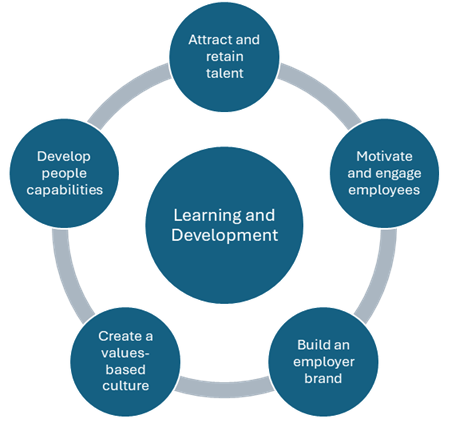
(Source: Adapted from
Nick van Dam, 25 Best Practices in Learning & Talent Development, 2nd edition, Lulu Press, 2008)
Role of the Individual
Seek and reflect on feedback.
Assess personal skills and knowledge to identify areas for improvement.
Actively pursue opportunities to address skill and knowledge gaps.
Apply new knowledge in practice.
Share learning and insights with the team to foster continuous improvement.
Role of Line Managers
Role model a learning culture by actively engaging in their own learning and development.
Set clear expectations and goals for their team. Including defining job responsibilities, performance targets, and the skills and behaviours needed to achieve them.
Provide constructive feedback and coaching to foster both individual and team growth. Contribute to the team’s understanding of how they contribute to the organisation’s goals.
Through regular performance reviews and 1-1s actively support development by identifying skills gaps and facilitating personalised learning opportunities. This includes arranging observation sessions, mentoring and competency checking, with formal training.
Integrate learning into daily work activities by encouraging problem-solving and sharing of best practices.
Observe and document behaviour change following training to feedback to the L&D department. This data is essential to assess learning transfer and identify areas for improvement.
Plan and review induction programmes to help new employees integrate smoothly into their new roles.
Collaborate with the L & D department and Clinical Governance (CG) when onboarding new services to identify and plan how L&D needs will be met.
Conducting a learning needs analysis (LNA) with the L&D department when gaps are identified ensures the learning environment, processes and procedures are considered.
Role of the L&D Department
Collaborate with operations and CG when onboarding new clients or services to identify and plan training needs.
Conduct an LNA to determine skills and knowledge gaps.
Differentiate between learning, process, and environmental needs to design appropriate training solutions.
Set clear learning objectives and use evidence-based practices to develop training programs.
Deliver training through various methods, including remote, in-person, e-learning, and blended approaches.
Conduct learning transfer analysis post-training to assess the effectiveness of learning outcomes.
Report on L&D functions to senior management to ensure alignment with organisational goals.
Role of the Organisation
Recognise that the quality of service is determined primarily through clinician efforts.
Emphasise core values and behaviours during regular appraisals.
Facilitate access to training and development through in-house and external training.
Support apprenticeships where feasible.
Consider financial support for higher education or professional qualifications.
This article provides a comprehensive overview of the roles and responsibilities necessary for an effective L&D strategy within an organisation. By clearly defining these roles, OH organisations can ensure that their L&D programs are successful and contribute to overall business goals.
Not all organisations have separate L&D, CG and operational departments; however, this can be a good guide to map within organisations.
This article was provided by PAM Academy, the L&D department of PAM Group.

Share