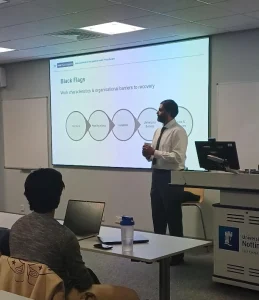
I watched the four pre-recorded lectures by Professor Steven Sadhra, which I found surprisingly engaging, even though many of my peers didn’t seem to. But the real spark came during the tutorial. It was run by an Occupational Health doctor whose name I’ve forgotten — but whose influence has stuck.
She guided us through a case involving a 35-year-old metal arc welder in a light industrial factory with back pain. It seemed straightforward at first, but as we discussed the job role, hazards, return-to-work factors, and psychosocial elements, I found myself getting more and more drawn in.
 What really grabbed my attention was the idea of site visits — actually going to see someone’s workplace, not just reading about it. That felt incredibly practical and grounded in real life.
~
At Birmingham, we’re given five weeks at the end of fourth year where we can arrange our own placement — the Selected Career Experience (SCE). I knew I wanted to do something different, with variety and practical relevance, and Occupational Health ticked most boxes. I reached out to several doctors and was fortunate that Dr Helena Nixon at University Hospitals Birmingham agreed to supervise me.
By the time I started, my expectations had been shaped by what we’d been taught in GP — motivational interviewing, encouraging return to work, advising adjustments, using fit notes. I imagined a multidisciplinary field combining clinical medicine, psychology, public health, risk assessment, and employment law. I also hoped to see more of the preventative side of things — like health surveillance. My goal was to explore as many angles of OH as I could.
The department helped me build a really varied timetable. I attended management referral clinics, which made up a lot of my placement. These focused less on diagnosis and more on function — how someone’s condition impacts their job. I was surprised to learn that OH doctors don’t have access to full patient records and instead must request information from other teams with consent. Yet consultations carried on regardless, built around detailed histories covering symptoms, role demands, work patterns, and existing support.
I’ll admit I had slightly rose-tinted expectations — I thought most outcomes would involve reasonable adjustments and a supported return to work. But I soon realized that OH recommendations can also include redeployment or even medical dismissal. That aspect of the work hadn’t crossed my mind before.
Alongside clinics, I spent time with the Ergonomics team, visiting offices, wards, and even a pathology lab. Seeing how posture, task repetition, and equipment setup could contribute to long-term MSK problems was eye-opening. I hadn’t expected ergonomics to include things like temperature, lighting, or even noise levels — but it did, and it challenged what I thought the field was about.
I also joined the Wellbeing Hub, sat in on an Occupational Psychiatry clinic, attended patch testing in Dermatology, and joined TB and Hep B clinics in Infectious Diseases — all through an occupational lens. It showed me just how much OH overlaps with other specialties, even if it often goes unnoticed.
My placement ended with the RSM/SOM conference on “Health and Employment in Transition.” It was slightly intimidating as a student, but fascinating — and seeing Dr Aaliya Goyal, who I’d met in Week 1, made it much more approachable. The talks covered flexible working, AI, and wider national workforce challenges — far beyond what’s typically discussed in medical school.
This SCE experience has made me far more conscious of how health and work intersect. I’m seriously considering completing the Diploma in Occupational Medicine post-FY2, even if I take a different clinical path. What I’ve come to realise is that supporting someone’s ability to work can be just as meaningful as treating the illness itself — and Occupational Health is uniquely placed to do that.